Updated August 12, 2026It resolved, and not the way the countdown implied. On July 20 Anthropic stopped moving the deadline and made Fable 5 a standard part of the plan for Max and Team Premium, included at up to 50% of weekly usage limits, no credits and no expiry date. Pro and Team Standard went the other way: Fable is outside plan limits and runs on usage credits, softened by a one-time $100 credit. The promotional period formally ended July 19 at 11:59:59pm PT. What changed underneath was supply, not policy: the SpaceX Colossus 1 deal added more than 300MW and over 220,000 NVIDIA GPUs, alongside efficiency work that cut the per-call cost of frontier inference.
MAX + TEAM PREMIUM · INCLUDED50% OF LIMITSPRO · CREDITS ONLY$100 ONE-TIME CREDIT
Updated July 8, 2026Anthropic blinked. The July 7 cutoff came due, the backlash landed, and the deadline moved: Fable 5 now stays in Claude plans through Sunday, July 12 at 11:59pm PT, same 50% weekly cap. From July 13 it lives outside usage limits: credits only, switched on under Settings. No credits, no Fable. The API is untouched. Full picture in Fig. 4 below.
JUL 13 · OFF PLANS$10 / M IN$50 / M OUT$2,000 / DAY CAP

For nearly three weeks, the best coding model in the world did not exist. Not deprecated, not rate-limited. Off. On June 12 a US export-control directive forced Anthropic to switch Claude Fable 5 off for every customer on the planet, and it stayed dark until July 2.

If you had wired a workflow around it that first week, you did not have a slow model or an expensive one. You had nothing. That is the part worth sitting with, because the model is back now, and the temptation is to exhale and forget it happened.

The Model That Vanished

Fable 5 launched on June 9 as the strongest coding model anyone had shipped: first on GDPval, 95% on SWE-bench Verified, the clear frontier. Three days later it was gone. The Department of Commerce issued an export-control directive citing national security, and the way the rule was written, Anthropic could not simply fence off foreign access and keep the model live for everyone else. To comply, it had to disable Fable 5 and its unrestricted sibling Mythos 5 for all customers, everywhere.

The trigger was a jailbreak. Amazon researchers found a way around Fable 5's safeguards, prompting it to hunt for software vulnerabilities, and in one case it produced working exploit code. That finding is what set the export order in motion. Anthropic complied while saying plainly that it disagreed, and pointed out the uncomfortable part: the same demonstrations could be coaxed out of Opus 4.8, GPT-5.5, Kimi K2.7, Sonnet 4.6 and others. The capability was not unique to Fable. The directive landed on Fable anyway, and for the three weeks in between, the model was off.

Fig. 1
The outage log
Claude Fable 5 THE OUTAGE LOG JUN 9 TO JUL 13, 2026 THE DARK PERIOD JUN 9 Launched at the frontier first on GDPval, 95% SWE-bench JUN 12 Switched off worldwide Amazon jailbreak, export controls JUN 30 Controls lifted rollout begins July 1, still governed JUL 2 Back, with a governor routine work falls back to Opus 4.8 JUL 13 Leaves Claude plans again extended once Jul 8; then credits only, $10 in / $50 out per Mtok 20 DAYS DARK the best coding model on earth, off for every customer, everywhere Jun 12 off Jul 2 back Jul 13 off plans
Launched June 9. Off for the whole planet from June 12, after a third party's jailbreak triggered the export order. Back July 2, redeployed with a heavier hand, extended once on July 8, and off Claude plans from July 13: outside usage limits, billed only through credits. The number is the point: for anyone who built on it, twenty days was not a slower model, it was zero.

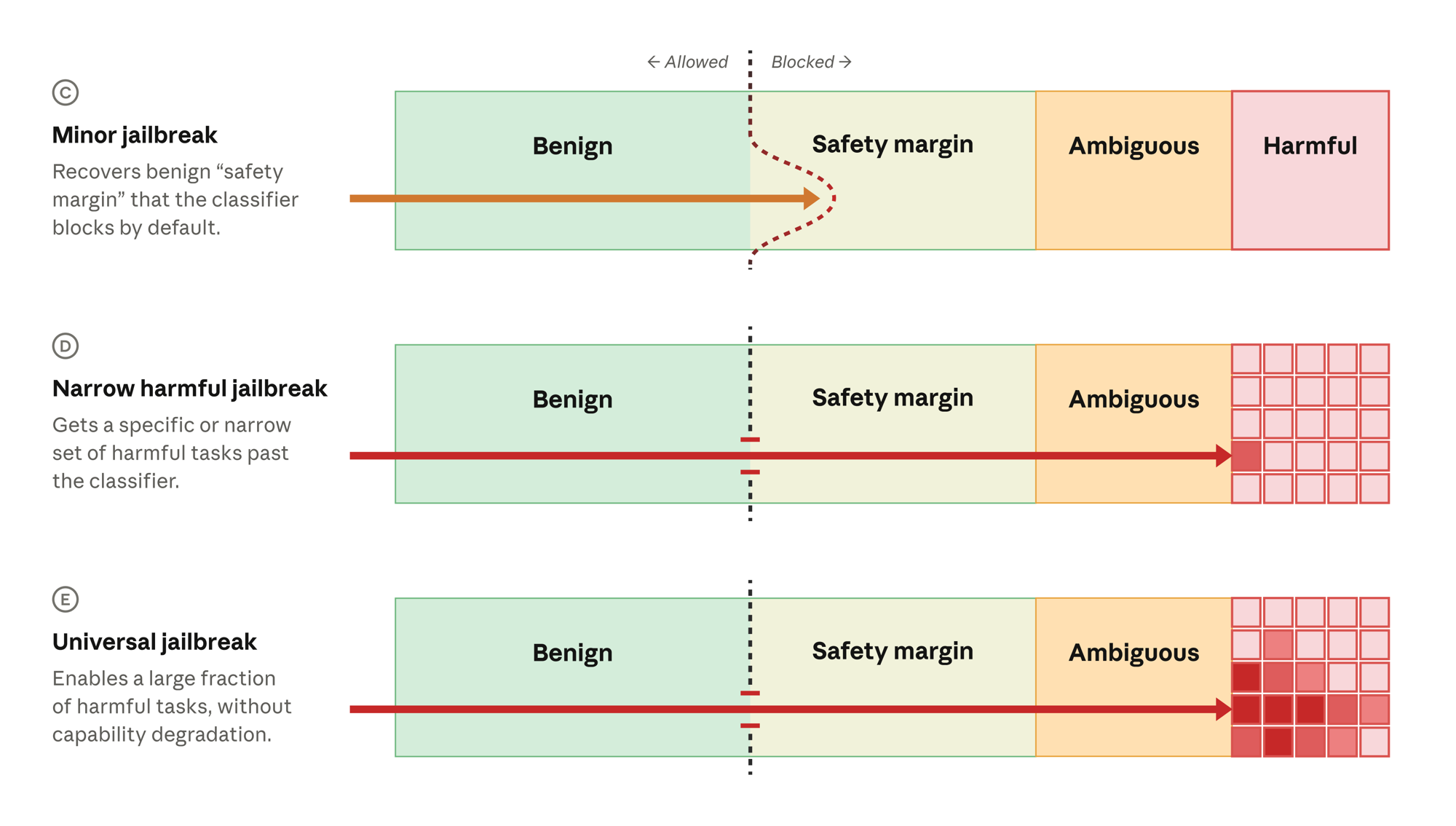
Here is the part that should unsettle anyone building on a single model. On Anthropic's own severity scale, the reported Fable jailbreak was the mildest kind, a minor one that recovers benign work the classifier blocks by default, not a universal break that unlocks real harm. A minor, third-party finding still took the best coding model on earth offline for every customer on the planet. You do not get a vote.
Claude Fable 5 · Fig. 2 · via Anthropic
How big was the hole?
Anthropic's jailbreak severity diagram. Three rows: a minor jailbreak recovers benign work inside the safety margin; a narrow harmful jailbreak gets a specific set of harmful tasks past the classifier; a universal jailbreak unlocks a large fraction of harmful behavior. The reported Fable 5 case was the minor kind.
Anthropic's own severity scale. The reported Fable jailbreak sat at the mildest rung, row C, recovering benign work the classifier blocks by default, not the universal break of row E. A minor finding, and it still pulled the model for the whole planet.
Chart: Anthropic, “Redeploying Fable 5,” June 30, 2026 · anthropic.com

It Comes Back Changed

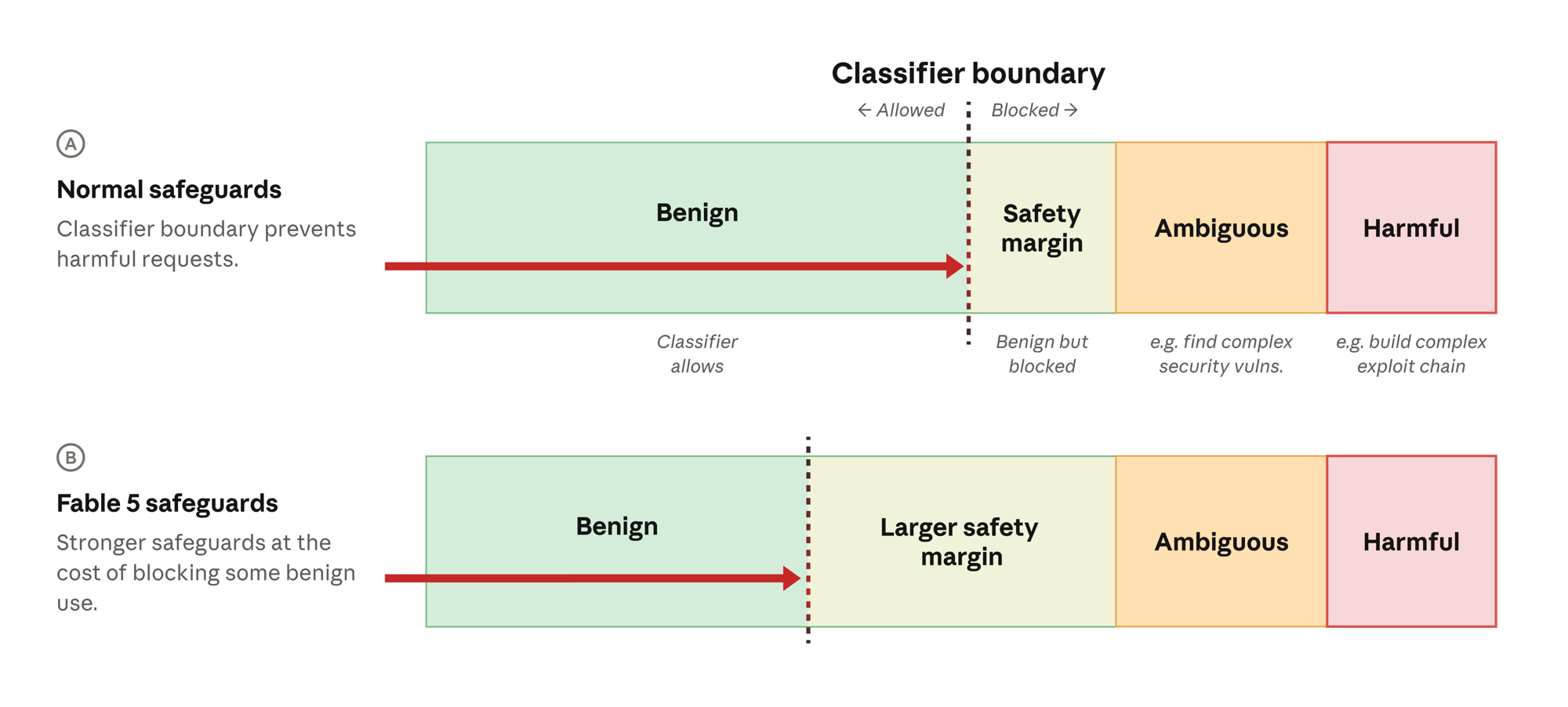
On June 30 the Commerce Department lifted the controls, and Anthropic began redeploying Fable 5 globally over the next two days, broadly available again by July 2. But read the fine print on the return. The model comes back behind a new safety classifier tuned to block the reported technique in more than 99 percent of cases, and to buy that margin Anthropic widened the boundary so far that it now catches benign work too. In the near term, routine coding and debugging fall back to Opus 4.8 while the classifiers settle.
Claude Fable 5 · Fig. 3 · via Anthropic
Back, behind a wider line
Anthropic's classifier boundary diagram. Row A, normal safeguards: the classifier boundary sits at the edge of benign requests. Row B, Fable 5 safeguards: a much larger safety margin pushes the boundary into benign territory, blocking some benign use.
Why the return feels governed. For Fable 5, Anthropic pushed the safety margin past the harmful zone and into benign work, so almost none of the reported technique gets through. The cost is that ordinary coding trips the same line, and gets routed to Opus 4.8.
Chart: Anthropic, “Redeploying Fable 5,” June 30, 2026 · anthropic.com

And now read the asterisk in the headline. Fable 5 was included in Pro, Max, Team and select Enterprise plans only through July 7, at up to half of weekly usage limits. Then the backlash landed, and on July 8 Anthropic moved the deadline once: five more days, through Sunday July 12 at 11:59pm PT, same 50% cap. From July 13 it comes off subscriptions entirely and lives outside usage limits altogether: it bills only through usage credits, at $10 per million tokens in and $50 out, the same meter the API has charged from day one. You switch credits on under Settings, load a balance (redemptions cap at $2,000 a day, auto-reload optional), and every Fable token draws it down. No credits enabled, no Fable. The API and consumption-based Enterprise plans are untouched.

Claude Fable 5 · Fig. 4
Eleven days in plans, then the meter
Claude Fable 5 THE JULY 13 CLIFF JUL 2 TO JUL 13, 2026 · EXTENDED JUL 8 11 DAYS IN PLANS back July 2, extended July 8, off plans July 13 IN CLAUDE PLANS up to 50% of weekly usage limits Pro, Max, Team, select Enterprise JUL 13 OUTSIDE USAGE LIMITS usage credits only JUL 2 JUL 12 JUL 13 INPUT $10 / M tokens OUTPUT $50 / M tokens CREDIT CAP $2,000 / day No credits enabled, no Fable. The API and consumption Enterprise plans are untouched.
The cliff, once postponed. Eleven days inside Claude plans, counting the five-day extension Anthropic granted on July 8 after the backlash. At July 13 the line drops out of usage limits entirely and onto the meter: $10 in, $50 out, per million tokens, capped at $2,000 of credit a day. Anthropic calls it temporary. No date attached.

Anthropic insists the removal is not permanent. Demand, it says, is "very high, and difficult to predict," and it aims to restore Fable as a standard part of subscriptions "as soon as capacity allows." No date attached. Days after the model came back, it leaves again for everyone who does not pay separately for it. If you are staying on Fable past the cutoff, the routing playbook for not paying full price is here.

So the thing that came back on July 2 is not quite the thing that left on June 12. It is Fable 5 with a heavier hand on the wheel, quietly routing some of your everyday work to a different, older model, and on a meter that starts July 13. Better than dark. Not the same as before.

Left June 12

The full model

Coverage
Every task ran on Fable 5.
Classifiers
Query-level reroute on the highest-risk work only.
Access
Broadly available worldwide.
Back July 2

Fable, with a governor

Coverage
Routine coding and debugging fall back to Opus 4.8.
Classifiers
Heavier cyber blocking, more false positives for weeks.
Access
Off plans after July 12 (extended once). Outside usage limits: credits at $10 in / $50 out per Mtok, or nothing.

The Model Is a Tenant

Here is the lesson, and it has nothing to do with export policy. The most capable model you can buy is a dependency you do not control. It can be switched off by a directive you never saw coming, it can come back changed without asking you, and it can come back metered: eleven days after the return, it leaves subscriptions again for anyone who has not enabled usage credits. For three weeks, every team that had wired Fable 5 into the center of how they work was building on sand.

Some of them watched what filled the gap. While Fable was dark, an open-weights model, Z.ai's GLM-5.2, quietly took the top spot on Design Arena's web-design board, the first open model ever to do it. The frontier did not stop moving because the leader was unplugged. It just moved somewhere you could actually run.

Aaron Levie
Aaron
Levie

"The big winner in all of this is going to be open weights models."

Aaron Levie, CEO of Box  ·  June 2026

The teams that felt it most were the ones moving fastest. At Every, Dan Shipper had the crew racing the clock in the short window before the shutdown landed, treating a frontier model as a resource that might not survive the week.

Dan Shipper
Dan
Shipper

"BUILD EVERYTHING."

Dan Shipper, CEO of Every, in the window before shutdown  ·  June 2026
Fig. 5
Rent the model, own the loop
Claude Fable 5 RENT VS OWN THE OPERATOR LAYER vs RENT · VOLATILE the model best this month switched off by a directive you never see here today. gone Jun 12. OWN · PORTABLE your operator layer Context Skills Workflows Customer Graph YOURS · SWAP THE MODEL UNDER IT Rent the model. Own the loop.
The rented model dissolves at the edge, gone by a directive you never see. The owned stack, the context you feed it, the skills and workflows you built, the map of your business it reasons over, sits on a foundation you keep. Point it at a different model and keep working.

What This Means If You Are Building

The answer is not to bet on the other lab. Codex could be next. Any model behind an API can be. The answer is to stop treating the model as the thing you own. Own the layer around it instead: the context you feed it, the skills and workflows you have built, the map of your business it reasons over. That layer is portable. Point it at a different model on a Tuesday and keep working.

This is the whole idea behind an operator layer, and it is what we install on site. Build so the model can disappear, because sometimes it does. Keep an open-weights option warm so you are never one directive away from dark. Rent whatever model is best this month. Own the loop that makes it useful.

Fable 5 is back, and it is still, on its day, the best in the world. Use it. Just do not build your company on the assumption that it will be there tomorrow.

How It Actually Ended

On July 20 the countdown stopped. Anthropic made Fable 5 a standard part of Max and Team Premium, included at up to 50% of weekly limits, with no expiry attached. Pro and Team Standard went the other way and now reach it through usage credits, cushioned by a one-time $100 credit.

The reason was supply rather than a change of heart. The SpaceX Colossus 1 deal added more than 300MW and over 220,000 NVIDIA GPUs to what Anthropic could draw on, and efficiency work brought down the per-call cost of frontier inference. The constraint that produced three moving deadlines got relieved, so the deadlines stopped moving.

Four days later Anthropic shipped Opus 5 at $5 in and $25 out, close to Fable on most work at half the price, and unlike Fable it is compatible with zero data retention. For a lot of teams that had spent June and July rearranging their stack around Fable access, the practical answer arrived from a different direction entirely.

Which is the point the whole episode keeps making. Three deadlines, one reprieve, one permanent inclusion, one tier demoted to credits, and a cheaper model that resolved the problem sideways, all inside seven weeks. None of that was predictable in June, and none of it is the kind of thing you can plan a company around.

Rent the model. Own the loop.

Own the layer, not the model.

Book a free Diagnostic: 30 to 45 minutes, no deck, no pitch. We map what you have built on top of a single model, and where an operator layer you own, the context, skills, and workflows, would keep you running when the model does not.

Book the Diagnostic →
Sources
1Anthropic (@AnthropicAI), July 1, 2026. Department of Commerce lifted export controls on Claude Fable 5 and Mythos 5; Fable 5 available again globally July 2, redeployed with new classifiers, routine coding and debugging falling back to Opus 4.8 near term, plus a consensus framework with Amazon, Microsoft, Google and Glasswing partners on assessing jailbreak severity. x.com · x.com
2Anthropic, “Redeploying Fable 5,” June 30, 2026. Amazon researchers found a technique bypassing Fable 5's safeguards to identify software vulnerabilities, in one case producing exploit code; the same demonstrations were reproducible on Opus 4.8, GPT-5.5, Kimi K2.7, Sonnet 4.6 and others. The finding set US export controls in motion, disabling Fable 5 and Mythos 5 for all customers on June 12. Controls lifted June 30; redeployed globally from July 1 behind a widened safety classifier that blocks the reported technique in over 99% of cases, with routine coding and debugging falling back to Opus 4.8. On Pro, Max, Team and select Enterprise plans Fable 5 is included for up to 50% of weekly usage limits through July 7, then comes off subscriptions and moves to usage credits at $10 in / $50 out per million tokens; without credits enabled, access ends. The classifier-boundary and jailbreak-severity charts above are reproduced from this post. anthropic.com
3Every (Dan Shipper), June 2026. Fable 5 abruptly disabled around June 12, the best coding model Every had tested; the team told to build everything in the short window before shutdown; the removal became the canonical case study for model impermanence.
4Aaron Levie, CEO of Box, June 2026, on the suspension: "The big winner in all of this is going to be open weights models."
5Artificial Analysis / Design Arena, June 2026. Z.ai's GLM-5.2 took the top spot on single-turn web design while Fable 5 was unavailable, the first open-weights model to lead the board.
6BleepingComputer, July 2026, "Claude Fable 5 isn't permanently leaving subscriptions, Anthropic says." Anthropic confirmed Fable 5 comes off subscription plans after July 7 and moves to usage credits, citing demand it expects to be "very high, and difficult to predict"; it aims to restore Fable as a standard part of subscriptions "as soon as capacity allows," with no committed date. bleepingcomputer.com
7Claude Help Center, “Manage usage credits for paid Claude plans,” July 2026. Mechanics of the meter Fable 5 moves to on July 8: enable usage credits under Settings → Usage, add funds, $2,000 daily redemption limit, optional auto-reload; Fable 5 tokens bill against the credit balance at API rates. support.claude.com
8Anthropic subscriber email, July 8, 2026 (via subscriber screenshots on X), plus Forbes, “Claude Fable 5 Extends By Five More Days,” July 7, 2026. The extension: “Claude Fable 5 was set to start drawing from usage credits on July 8, but we've extended our promotion period and it now stays in your plan through Sunday, July 12 at 11:59 pm PT.” Same 50% weekly cap; usage credits from July 13. forbes.com
John Tan
John Tan

Founder and CEO of nativefirst.ai. Embeds with scaling founders and CEOs to ship Level-3 agents and AI workflows in production.